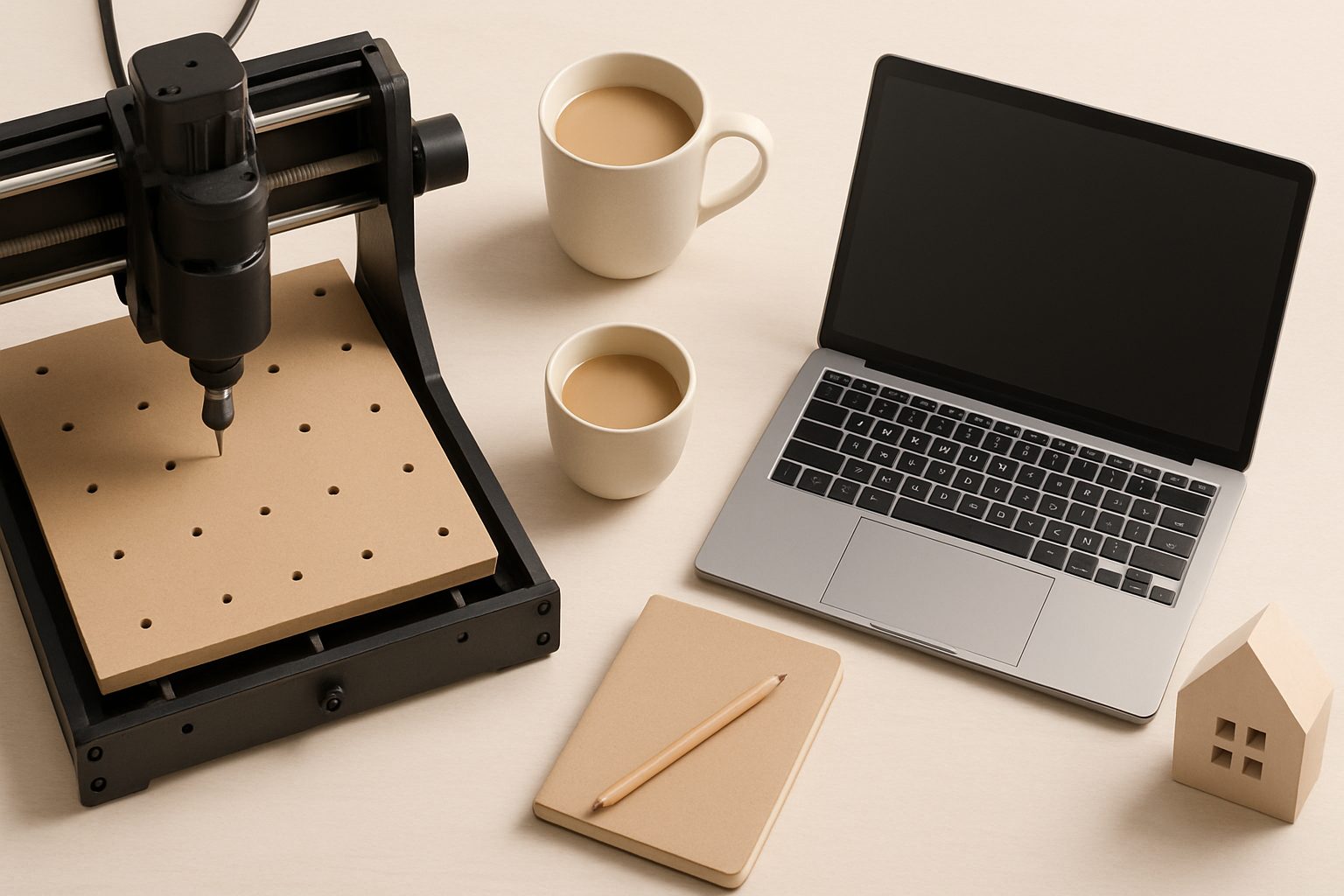
Best CNC Routers for Sign Making UK 2025: Cut Crisp Letters Every Time
Sign making has become one of the most lucrative applications for small-shop CNC routing. Whether you're carving wooden signs, cutting acrylic, or engraving metal composites, the machine you choose determines whether your letters stay razor-sharp or come out frayed and disappointing. After running sign-making workshops and testing routers myself, I can tell you which machines actually deliver consistent, crisp results—and which ones leave your customers unimpressed.
What Makes a Good Sign Router?
Not every CNC router suits sign work equally. You're not just cutting profiles; you're creating fine details that sit at the edge of what affordable hobby machines can do.
Cutting area matters more than raw horsepower. Most signs sit in the 600–800 mm width range—a A2 board or smaller. If your machine can't fit that in one run, you're joining pieces or rotating stock, which tanks repeatability. Larger beds give you flexibility without compromising.
V-bit compatibility is non-negotiable for sign making. V-bits let you cut clean bevelled edges and fine text in a single pass. A machine that wobbles or has runout (the spindle isn't perfectly centred) will produce inconsistent V-groove widths across a single letter. That's the difference between £30 and £300 custom signs.
Rigidity and spindle quality determine whether your ¼-inch letter stays sharp at the point. Chatter (vibration during the cut) is your enemy here. Cheaper routers with flimsy gantries produce fuzzy edges; better machines keep geometry stable even at fine depths.
Shapeoko 4: The Versatile Workhorse
The Shapeoko 4 is arguably the most popular CNC router in UK maker spaces, and for good reason. It's not a specialist; it's a remarkably well-balanced machine that happens to excel at signs.
The strengths: The 750 × 750 mm cutting area handles most signs in a single pass. The spindle runout is tight (around 0.1 mm), which keeps V-grooves consistent. Carbide Motion software is intuitive; Fusion 360 integration works smoothly. You get real precision at a price that doesn't require a business loan.
The Shapeoko ecosystem is mature. Thousands of UK users mean forums are active, jigs are shared, and you're never stuck on an obscure problem. The community has published sign-making profiles and feeds-and-speeds that actually work.
The catch: The Shapeoko 4 is not the fastest machine. Cutting hardwood like oak at production speed still takes time—a 400 × 200 mm sign might take 15–20 minutes depending on detail. If you're running a high-volume sign business, you'll hit the ceiling. It also takes real space; you need at least 1.5 × 1.5 metres of floor room including access.
Z-height is 100 mm, which is plenty for V-grooves but feels tight if you ever want to flip material or carve deeper relief patterns. The machine is also louder than budget machines—around 80–85 dB during cutting, which might matter if you're in a domestic workshop.
Cost and availability: Shapeoko 4 standard model costs roughly £2,500–£3,200 in the UK, depending on bed size. UK distributors exist, which means you're not paying three months for shipping if something fails.
BobsCNC Evolution 4: The Budget Operator's Choice
If budget is your primary concern but you won't compromise on cutting area, the BobsCNC Evolution 4 deserves attention. It's a larger, wood-frame machine designed for hobbyists and small producers.
The strengths: The cutting area is genuinely impressive—1000 × 750 mm, sometimes larger depending on configuration. For sign makers, that's huge; you can fit multiple medium signs on one sheet. The DeWalt spindle is robust and handles V-bits well. Build cost is genuinely low—around £1,500–£2,000 in parts, or £2,800–£3,500 assembled.
Rigidity is solid for the price. Wood framing isn't as inert as aluminium, but BobsCNC has engineered it well enough that V-grooves stay consistent across the bed. Collet runout is respectable.
The catch: You're expected to handle assembly and tuning. BobsCNC machines ship as kits; you're bolting it together yourself. That's fine if you're handy, but it adds 20–30 hours and demands mechanical patience. Software support is less polished than Shapeoko. Fusion 360 integration exists but feels clunky compared to alternatives.
The larger frame and wood construction take up real space. You're looking at a 2 × 1.5 metre footprint. UK support is thinner; spares and advice come via US-based forums, which occasionally means waiting for replies.
Travel on Z-axis is around 75 mm, slightly limited for certain applications.
Setting Up for Sign Success
Regardless which machine you choose, sign making imposes specific demands:
- Dust collection is essential. Sign dust contains fine particles that clog spindle bearings. A 4–6 kW dust extractor is non-negotiable.
- Jigs and holding matter more than the router itself. Clamping sheet material securely in repeatable positions is what separates pro-looking signs from wonky ones.
- Calibration and runout checking should be routine. A simple dial indicator (£30) caught dozens of hours of failed cuts in my own workshop.
- V-bit choice matters. Cheap V-bits produce dull edges. Amana, Freud, and Whiteside bits cost more but hold geometry across hundreds of cuts.
The Verdict
For most UK sign makers, the Shapeoko 4 is the smarter choice. The 750 × 750 mm bed is genuinely adequate for 95% of work, software is mature, and the community is active. You're paying for support and reliability.
The BobsCNC Evolution 4 makes sense if you're running higher volume, have the space, and don't mind assembly and tuning. The larger bed eventually pays for itself in fewer sheet passes.
Either way, you're buying into a platform, not just a machine. Choose the one whose community and ecosystem support how you actually work.
More options
- Genmitsu CNC Routers (SainSmart range) (Amazon UK)
- Shapeoko CNC Router & Accessories (Amazon UK)
- CNC Router End Mill & Bit Sets (Amazon UK)
- CNC Spindle Kits & VFD Controllers (Amazon UK)
- BobsCNC Evolution 4 & Accessories (Amazon UK)